
Priscilla Bianchi learned to sew at age 4. She had to stand at the machine because she couldn’t reach the pedal. The machine was a Singer treadle—her mother’s grandmother’s—and when the young Priscilla got it moving, she felt something she’s never quite stopped chasing. “I remember the feeling of ‘powerful,’” she says. “Like, this is roaring and I’m doing it.” She’s been sewing ever since.
Bianchi is now a textile artist, designer, writer, and teacher based in Guatemala City. She exhibits internationally, has designed fabric for Robert Kaufman, written three books, and had her quilts acquired by institutions including the Museum of Arts and Design in New York City. In 2010, the Guatemalan Postal Service featured ten of her quilts on a stamp edition that printed 3.5 million copies—and has been reprinted several times since.
She’s also, for the past 20 years, been the academic principal of one of Guatemala’s top private schools. When people learn this, they tend to do a double take—and Bianchi enjoys the reaction.
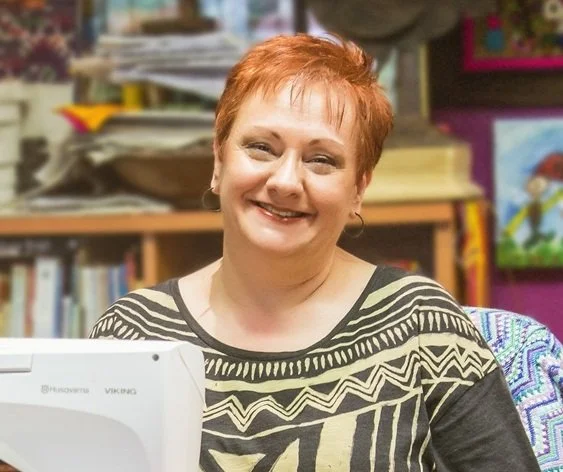
Priscilla Bianchi
From Clothes to Quilts
Bianchi’s mother taught her to sew for practical reasons. “I was a very restless girl,” she says, “and she needed to teach me things that would keep me busy for long periods of time.” It worked. By 11, she was attending a formal sewing class and making her own clothes. She’d see something in a magazine and copy it.
She kept sewing her own wardrobe until she turned 40, when, as she jokes, she stopped wanting to know her measurements. Her hands, though, still needed something. She’d dabbled in watercolors, acrylics, oils, knitting, crochet, embroidery. Nothing stuck.
Then a quilt book arrived in a monthly book club shipment—Beth Donaldson’s Charm Quilts—and she read it cover to cover in two days. “When I realized that art quilting had absolutely everything that I loved in one package—the fabrics, the sewing, the design, the art, the creating—it was just like a match made in heaven.” She pulled fabrics from her stash and started cutting. “It was like I was alive. I could feel the rush of blood running through my veins.”
She finished 36 quilts in her first year. She was sewing until 3 AM most nights, keeping a notebook by her bed to capture the shapes and colors that kept her awake.
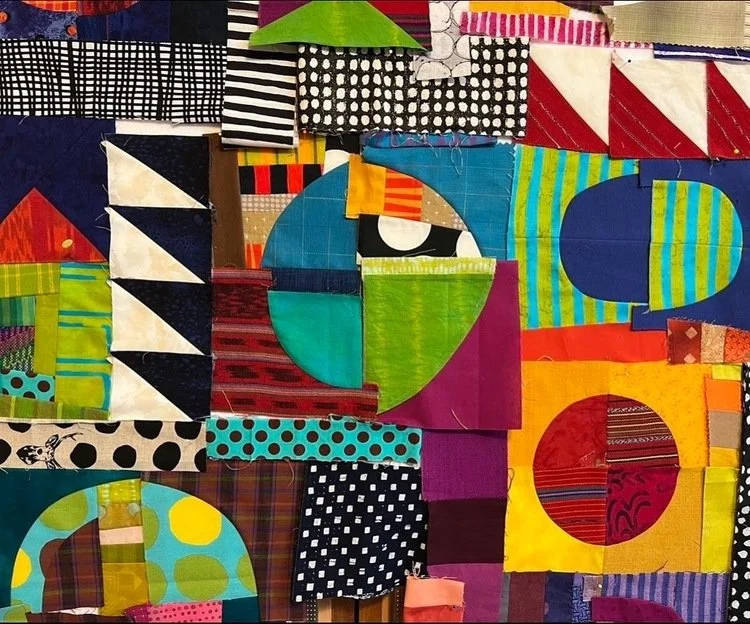
Priscilla’s quilts are fearless in their use of colors and patterns.
Guatemala in Every Stitch
Six months into her quilting life, Bianchi quit her human resources consulting firm to sew full time. She started showing her work—first at Guatemala City’s Ixchel Museum of Indigenous Textiles, where her first solo show opened in 1999, two months after she walked in cold and asked for a gallery slot. “I didn’t believe I was a quilt artist,” she says. “But that was my pitch.”
A year or two later, she mailed 30 handmade portfolios to 30 US museums and galleries. The La Conner Quilt Museum in Washington wrote back. Then the Rocky Mountain Quilt Museum in Colorado. Then, in 2003, a solo show at the Houston Quilt Festival—which, she says, “catapulted me into the world.”
By then, she’d made what would become the defining decision of her career: her work would center on the Guatemalan textile tradition. At the time, there were nearly 30 million quilters in the US alone. Standing out required something no one else had.
“My immediate answer was Guatemala,” she says. “I come from a different culture. I have access to different materials. I’m surrounded by a culturally rich iconography, everything. That’s going to be my thing.”
Guatemala has over 300 distinct indigenous textile costumes—each community with its own patterns, color combinations, and symbols. The blouse worn by indigenous women, called a huipil, carries the densest symbolism: colors that represent blood, or corn, or the natural world; patterns that identify where a woman was born. “You can recognize where a person is from just by looking at the way they’re dressed,” Bianchi says.
She’s been studying these textiles for over 40 years. She collects traditional huipiles and sashes—but she doesn’t cut them. “I would never cut into a traditional textile. I respect the integrity of the cloth. I don’t dare cut into something that a woman has been weaving for 8 months or a year.” What she uses in her quilts is commercial handwoven Guatemalan fabric—still hand-woven, still saturated with the visual language of that tradition, but produced for the market rather than the body. The traditional pieces are her study material, her inspiration, her archive.
“With my work, you don’t get just me,” she says. “You get me and my culture, because it’s infused in everything I do.”
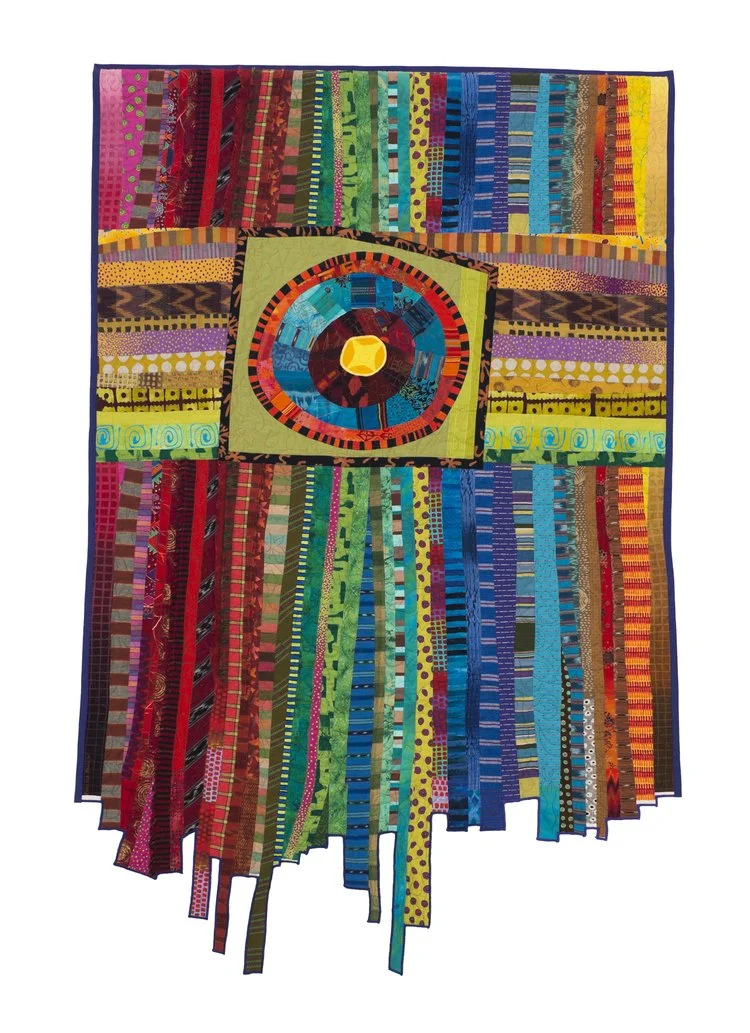
“The Big Huipil”
Quilt by Priscilla Bianchi
The Class That Can’t Be Dull
Bianchi has been teaching since she was 18. She’s been teaching quilting internationally for more than two decades, and she’s developed a clear philosophy about what a class should be: generous, joyful, and genuinely empowering.
“Most people are much more creative than they give themselves credit for,” she says. She likes to take students where they are and guide them to stretch out of their comfort zone—past the question of whether their husbands will like it, or whether their kids will approve. “The process needs to come from you, and you have to enjoy the process.”
She gives everything in a class. She’s encountered teachers who keep techniques back, who redirect questions to other courses. She finds it baffling. “If somebody asks something that’s not in the content of your class, it doesn’t take anything. It takes five minutes to tell the person whatever it is. And there’s no harm done.” Her classes, she says, are joyful and fun. “We laugh a lot!.”
The class she’s bringing to the Estelle Center for Creative Arts is the one she loves best: improv curves, waves, and circles, using hand-woven Guatemalan textiles as a foundation. Students work without rulers, plans, or templates—cutting freehand, trusting their eye, building a quilt that expresses their own voice rather than following a pattern.
Before the sewing begins, Bianchi opens with a visual tour of Guatemala: its markets, its people, its textiles. She wants students to understand why the work looks the way it does—to arrive at the color not as an assault but as a context. It’s the same invitation she’s been extending since she first walked into a museum with 36 quilts and no plan—only the conviction that what she had was worth seeing.
Ethnic Waves: Intuitive and Spontaneous Improv Curves and Circles with Priscilla Bianchi runs April 5–9, 2027, with a meet-and-greet the evening of Sunday, April 4. Confident beginner to advanced quilters welcome.
Marilyn Heywood Paige is the marketing director for the Estelle Center. This blog won the 2026 MarCom Blog Content Award and the 2025 DotComm award for Best New Arts Blog. She has also won two Hermes Creative Awards in 2026--a gold award for non profit branding and promotion work, and a platinum award for logo design.